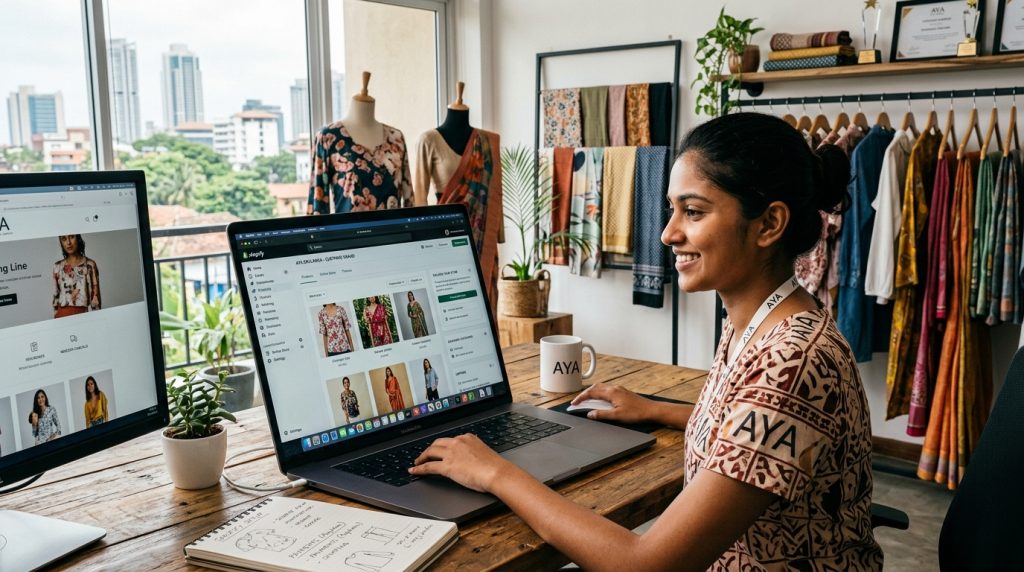
Sri Lanka has a growing number of clothing brands moving away from selling purely through Instagram and WhatsApp orders and into proper Shopify stores. Clothing is one of the more demanding categories to sell online well, since sizing, fit, and visual presentation carry more weight than almost any other product type. This guide covers what actually matters when building a Shopify store specifically for a Sri Lankan clothing brand, beyond the general Shopify setup steps, and where the store itself, the marketing that drives traffic to it, and even AI search visibility all connect.
As a certified Shopify Partner, Accel Asia builds fashion stores end to end, and also handles the PPC, SEO, and social media marketing needed to actually bring customers to a new store, along with AI Optimization work that helps a brand get found and recommended through AI search tools like ChatGPT and Google AI Overviews.
Why Clothing Brands Need a Different Approach on Shopify
Clothing has a higher return and exchange rate than most other product categories, largely due to sizing uncertainty, which makes a few store elements far more important for apparel than for other niches. Getting sizing information, product photography, and your returns process right early on will directly affect both your conversion rate and how much time you spend handling avoidable customer service issues later.
Get Your Sizing Information Right From the Start
Sizing confusion is the single biggest reason clothing purchases get abandoned or returned. A clear, consistent size chart on every product page, ideally in both international sizing and local Sri Lankan reference points such as chest and waist measurements in inches, reduces uncertainty for first time buyers. Many successful Sri Lankan clothing stores also add a short size guide video or a fit note directly on the product page, such as whether a piece runs true to size, small, or oversized.
Invest in Product Photography and Visual Presentation
Clothing sells on visuals more than almost any other category, and Shopify’s storefront is only as strong as the photography behind it. At minimum, each product needs multiple angles, a true to color photo taken in natural or neutral lighting, and ideally a photo showing the item worn on a model with a similar build to your target customer. Video content, even a short clip showing how fabric moves or fits, tends to noticeably increase conversion for apparel specifically, and is worth prioritizing over static images alone where budget allows. This same photography and video content also does double duty as the creative used in Meta and TikTok ad campaigns, which is one reason it’s worth planning photography and marketing together from the start rather than treating them as separate projects, something a full service agency like Accel Asia can plan for from day one.
Choose a Shopify Theme Built for Fashion
Not every Shopify theme handles clothing well. Look for a theme with strong image gallery support, built in size chart functionality, quick view options, and clean filtering by size, color, and category, since customers browsing a clothing store expect to filter quickly rather than scroll through an entire catalog. A slow theme is especially costly for fashion stores, since customers browsing visually heavy pages abandon slow loading sites faster than they do in other categories.
Set Up a Payment Gateway That Works for Sri Lankan Fashion Buyers
Clothing brands in Sri Lanka face the same payment gateway limitations as other Shopify sellers here, since Shopify Payments is not available locally. PayHere remains the most practical local gateway for LKR transactions, connecting directly to Sri Lankan banks and supporting cards, mobile wallets such as Genie, FriMi, and eZ Cash, and bank transfers. For clothing brands with customers in the diaspora, PayPal is worth adding alongside PayHere, since it now supports Sri Lankan merchants withdrawing to a local bank account.
Offer Cash on Delivery, and Plan for Returns and Exchanges
Cash on Delivery matters even more for clothing than for most other categories, since Sri Lankan shoppers are especially cautious about paying upfront for items they can’t try on first. Alongside COD, a clear returns and exchange policy displayed prominently on product pages and at checkout reduces pre purchase hesitation and builds trust with first time buyers. Clothing brands that make sizing, returns, and exchange terms easy to find tend to see meaningfully lower cart abandonment than those that bury this information in a footer link.
Organize Your Store by Collection, Not Just Category
Fashion customers shop by occasion, season, and style as much as by product type. Structuring your Shopify store into collections such as new arrivals, festive wear, casualwear, or seasonal drops, rather than only broad categories like shirts or dresses, mirrors how customers actually browse and makes it easier to merchandise new stock and run targeted promotions around specific collections.
Set Up SEO for Fashion Specific Searches
Clothing shoppers often search with very specific terms, such as a style, fabric, or occasion, rather than generic product names. Product titles and descriptions should reflect this, using natural language that matches how customers actually search, such as linen shirts for men Sri Lanka or party dresses Colombo, rather than generic labels alone. Each collection page should also have its own optimized title and description, since collection pages frequently rank and convert as well as individual product pages for fashion stores.
Traditional SEO is no longer the only visibility channel worth planning for. A growing number of shoppers now ask AI tools like ChatGPT or Google’s AI Overviews questions such as best linen shirts brand Sri Lanka directly, rather than searching and clicking through a results page. Structuring product and collection pages with clear, direct answers, consistent brand information, and genuine customer reviews improves a fashion brand’s chances of being the answer these tools surface. This is the AI Optimization and Answer Engine Optimization work Accel Asia builds into its SEO strategy for clothing brands, since being cited by an AI tool is quickly becoming as valuable as ranking on Google itself.
Market Your Clothing Brand After Launch
A well built store still needs consistent traffic to succeed, and this is where marketing needs to be planned alongside the store itself rather than as an afterthought once the store is live. For clothing brands in Sri Lanka, Instagram and TikTok tend to outperform other channels for driving both awareness and direct sales, given how visual the category is, and Meta Ads and TikTok Ads remain some of the strongest paid channels for reaching fashion buyers specifically. Google Ads, including Google Shopping ads, are also worth running once your product catalog is stable, since they capture customers already actively searching for specific items, and ongoing SEO and social media management help sustain traffic beyond what paid ads alone can deliver.
Accel Asia runs exactly this kind of full funnel marketing for clothing brands, covering PPC across Google, Meta, and TikTok, SEO, and social media management, alongside the Shopify development itself, so the store and the campaigns driving traffic to it are built by the same team rather than pieced together separately.
Useful Shopify Apps for a Clothing Brand
The right apps can solve many of the fashion specific challenges covered above without custom development. A handful of app categories consistently make the biggest difference for clothing stores.
Size chart and fit apps, such as Kiwi Sizing or similar size guide apps, let you add clear, consistent size charts across every product without manually formatting tables on each page, and some also include fit recommendation tools that reduce sizing related returns.
Product review apps, such as Judge.me or Loox, help build trust for new clothing brands by displaying customer photos and reviews directly on product pages, which matters even more for fashion since buyers can’t try items on before purchasing.
Upsell and bundle apps help increase average order value by suggesting matching items, such as recommending a belt or accessory alongside a dress, at checkout or on the product page.
Back in stock and restock notification apps let customers sign up to be notified when a sold out size or color returns, which is especially useful for clothing brands running limited drops or small batch collections.
Cart recovery and email marketing apps, such as Shopify’s built in email tools or Klaviyo, help recover abandoned carts, which tend to be common in fashion due to sizing hesitation, and support marketing to past customers ahead of new collection launches.
Shipping and courier integration apps connect your store directly to Sri Lankan courier services, allowing orders, including COD orders, to sync automatically instead of being processed manually for every sale.
It’s worth resisting the temptation to install every available app at once, since too many apps can slow down page load times, which works against the fast loading experience clothing stores need. A Shopify Partner agency can usually recommend the right small set of apps for a store’s specific catalog size and goals, rather than adding tools that add cost without meaningfully improving conversion. Accel Asia evaluates this app stack as part of every Shopify build, balancing functionality like size charts and reviews against site speed, since speed also directly affects both SEO and AI Optimization performance.
Examples of Successful Clothing Brands Built on Shopify
Looking at how established fashion brands use Shopify is a useful way to understand what separates a functional store from a genuinely high converting one, even though these are international examples rather than local ones.
Fashion Nova built its Shopify store around a constant stream of new arrivals and fast, image heavy browsing, which keeps repeat customers checking back frequently. Kith, a streetwear brand, relies on a minimalist, image focused layout and limited edition product drops to create urgency, showing how strong visual storytelling and simple navigation can work together on Shopify. Good American, a body positive denim and fashion brand, built its store around an unusually wide size range and size specific product photography, directly addressing the sizing uncertainty that affects most online clothing purchases. Chubbies grew a large, loyal customer base partly through consistent brand personality across its store and email marketing, showing that a clothing brand’s tone and storytelling matter almost as much as its product photography.
The common thread across these stores is that none of them treat Shopify as just a place to list products. Each uses the platform’s flexibility to reinforce a specific brand identity, address a specific customer hesitation such as sizing or trust, and keep the shopping experience fast and visually consistent. Sri Lankan clothing brands building on Shopify can apply the same principles at a smaller scale, since the underlying platform capabilities are the same regardless of store size.
Should You Build a Fashion Shopify Store Yourself or Hire a Professional?
Many Sri Lankan clothing brands start by building their own Shopify store, and for a small initial collection this can work reasonably well. As a brand grows, the gap between a store that simply displays products and one that’s genuinely optimized for fashion conversion, including sizing clarity, fast loading galleries, collection structure, and payment and COD setup, tends to widen quickly. This is typically where clothing brands bring in a Shopify Partner agency to rebuild or refine the store properly.
AccelAsia is an official Shopify Partner, one of only 13 in Sri Lanka, and has been building and optimizing Shopify stores, including fashion and apparel brands, since 2021. Beyond the store build itself, AccelAsia also handles the Marketing side, including PPC Ads across Google, Meta, and TikTok, SEO, and social media management, as well as AI Optimization, Answer Engine Optimization, and Generative Engine Optimization to help a clothing brand get discovered through both traditional search and AI powered search tools. For a clothing brand, having development, marketing, and AI visibility handled by one team usually means a more consistent brand experience and fewer gaps between what the store looks like and how it’s actually marketed.
Frequently Asked Questions
1. What Shopify theme is best for a clothing brand in Sri Lanka?
- The best theme depends on catalog size and style, but fashion focused themes with strong image galleries, built in size charts, and fast load speeds generally perform best. A theme built for general retail without these features usually requires customization to work well for clothing.
2. Should a Sri Lankan clothing brand offer Cash on Delivery?
- Yes, in most cases. COD is especially important for clothing since customers are often hesitant to pay upfront for items they haven’t tried on, and offering it typically increases conversion for first time buyers.
3. How important is product photography for a Shopify clothing store?
- It is one of the most important factors in a fashion store’s conversion rate, since customers can’t touch or try on the product before buying. Clear, true to color, multi angle photography, ideally including the item worn on a model, directly affects both trust and sales.
4. What payment gateway should a clothing brand in Sri Lanka use on Shopify?
- Most Sri Lankan clothing brands use PayHere for local LKR transactions, since it integrates directly with Shopify and supports local cards, wallets, and bank transfers. Brands selling internationally often add PayPal alongside it.
5. Is it worth hiring a Shopify agency for a clothing brand instead of building it myself?
- Building a simple store independently is possible, but clothing specific requirements such as sizing clarity, fast image heavy pages, and collection structure benefit significantly from professional setup. A Shopify Partner agency can help avoid the common mistakes that lead to high return rates and cart abandonment in fashion stores.
6. What apps does a Shopify clothing store need?
- A clothing store generally benefits most from a size chart app, a product review app, an email marketing or cart recovery app, and a shipping or courier integration app. Adding too many apps beyond these core categories can slow down the store, so it’s worth prioritizing a small, focused set over installing everything available.
7. Does AccelAsia only build Shopify stores, or does it handle marketing too?
- AccelAsia handles both. Alongside Shopify development, AccelAsia runs PPC Ads across Google, Meta, and TikTok, SEO, and social media management, plus AI Optimization, Answer Engine Optimization, and Generative Engine Optimization, so a clothing brand’s store, marketing, and AI search visibility are handled by one team rather than separate vendors.
Final Thoughts
A clothing brand’s Shopify store carries more weight than the store for most other product categories, since sizing, photography, and trust signals directly determine whether a visitor converts. Getting these fashion specific details right from the start, alongside the standard Shopify setup steps, gives a Sri Lankan clothing brand a real advantage over competitors still running their store purely as a generic template.
Want a Shopify store built specifically for your clothing brand by a certified Shopify Partner? Accel Asia has been building and optimizing Shopify stores for Sri Lankan businesses since 2021, and goes beyond development to run the PPC, SEO, and social media campaigns that bring customers to your new collections, plus AI Optimization work that helps your brand get found through AI search tools as well as Google. Get in touch to get started.