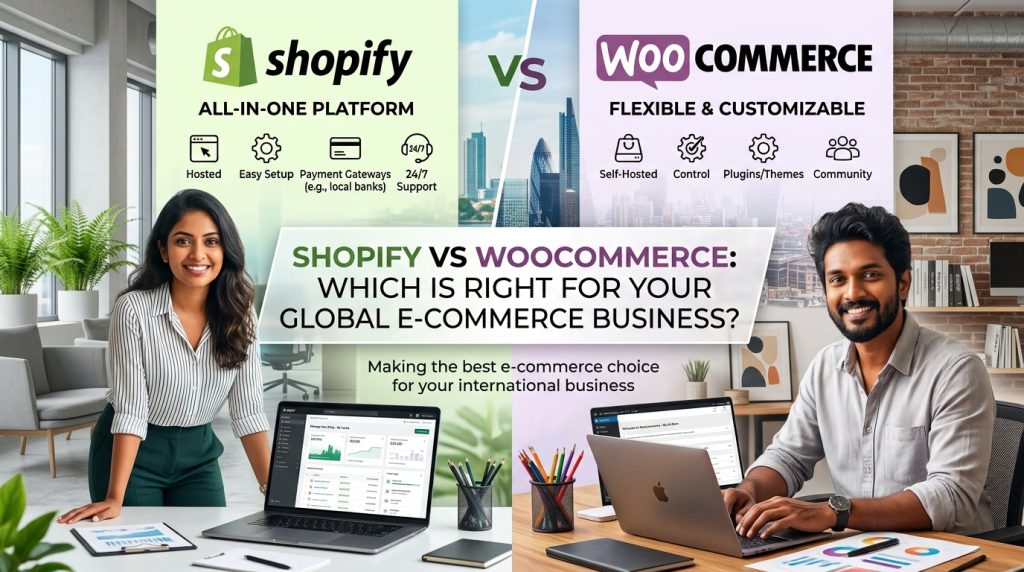
If you’re planning to launch or rebuild an online store in Sri Lanka, you’ve almost certainly landed on this question: Shopify or WooCommerce?
Both platforms can technically power an online store. But once you factor in what running an e-commerce business in Sri Lanka actually looks like (limited local dev resources, the need to move fast, and zero tolerance for downtime during a sale), one platform tends to come out ahead for most businesses: Shopify.
Here’s an honest, Sri Lanka-specific breakdown of why.
The Short Version
- Shopify is a fully hosted, all-in-one platform. Hosting, security, uptime, and updates are handled for you, so you can focus on running the business, not maintaining a website.
- WooCommerce is a free WordPress plugin, but “free” only refers to the plugin itself. Hosting, security, backups, and updates all become your responsibility, which usually means an ongoing dependency on developer support.
For most Sri Lankan SMEs, that difference alone tends to settle the decision.
1. Payments: Shopify Gets You There Just as Fast
Neither platform has Shopify Payments, Stripe, or PayPal checkout natively available in Sri Lanka, that’s a market limitation, not a platform one. Both Shopify and WooCommerce store owners connect to local gateways like PayHere or WebXpay to accept LKR payments, cards, and mobile payment methods.
The difference is how that integration holds up over time. Shopify’s app ecosystem includes vetted, actively maintained PayHere and WebXpay apps that install in minutes and are built to Shopify’s security and uptime standards. On WooCommerce, payment plugins are community-maintained, which means more flexibility on paper, but also more risk of a plugin breaking after a WordPress core update, right when you least want checkout to fail.
Takeaway: Both platforms reach the same local gateways. Shopify just gets you there with fewer moving parts to babysit.
2. Cost: Shopify’s Price Tag Includes More Than It Looks Like
Shopify is a predictable monthly subscription (plans typically start around $29+/month) that bundles in hosting, a global CDN, SSL, PCI-compliant checkout, and 24/7 platform uptime, infrastructure you’d otherwise have to buy, configure, and monitor separately.
WooCommerce looks cheaper at first glance because the plugin itself is free. But the real bill shows up in hosting, SSL, a reliable theme, premium plugins for things like backups and security, and, critically, ongoing developer time to keep it all running. For a lot of Sri Lankan businesses, that “invisible” maintenance cost ends up matching or exceeding what a Shopify subscription would have cost, minus the peace of mind.
Takeaway: Shopify’s price is the whole cost. WooCommerce’s price is just the starting cost.
3. Ease of Use & Maintenance: This Is Where Shopify Wins Outright
Shopify is built for business owners, not developers. Setting up products, managing orders, and running promotions takes minutes, not tickets to a developer. Security patches, backups, and platform updates happen automatically, in the background, with no risk of a plugin conflict taking your store offline mid-campaign.
WooCommerce demands real WordPress fluency, someone has to own plugin updates, security monitoring, and backups indefinitely. If that person leaves or your agency retainer lapses, the site’s stability is genuinely at risk.
Takeaway: If you don’t want e-commerce maintenance to become a part-time job, Shopify is the clear choice.
4. Scalability: Built for Growth Without the Growing Pains
Shopify is engineered to handle sudden traffic spikes (a Black Friday sale, a viral social post, a festive-season rush) without the site buckling. That reliability is baked into the platform, not something you have to engineer yourself.
WooCommerce can scale, but it takes deliberate, ongoing investment in hosting infrastructure, caching, and plugin optimization to get there, and it’s easy to get caught out the first time a promotion drives real traffic.
Takeaway: Shopify scales the moment you need it to. WooCommerce scales only if you’ve planned and paid for it in advance.
5. Local Logistics & Support
Both platforms connect to Sri Lankan couriers like Domex, Koombiyo, and CBS Courier through apps or custom integration. Shopify’s app store makes these connections faster to set up and easier to keep working, since apps are reviewed and maintained to a platform standard, versus WooCommerce, where courier plugins are more of a mixed bag in terms of long-term reliability.
On top of that, Shopify offers 24/7 global support directly from the platform, a safety net WooCommerce simply doesn’t have, since “support” there means whoever built your site.
Where WooCommerce Still Makes Sense
To be fair, WooCommerce isn’t wrong for everyone. If you already have strong in-house WordPress expertise, need a highly non-standard setup (complex wholesale logic, deep ERP integration, multi-vendor marketplace features), and are comfortable owning the infrastructure long-term, WooCommerce’s flexibility can be worth the added responsibility.
But for the vast majority of Sri Lankan retail, fashion, F&B, and D2C brands we work with, that scenario is the exception, not the rule.
So, Which Should You Choose?
| Choose Shopify if… | Choose WooCommerce if… |
|---|---|
| You want to launch fast and stay focused on the business, not the website | You already have strong in-house WordPress/dev expertise |
| You don’t want ongoing maintenance risk | You need highly non-standard, custom-built functionality |
| You want predictable costs and platform-backed uptime | You’re prepared to own hosting, security, and updates indefinitely |
| You’re planning to run sales, promotions, or seasonal traffic spikes | Your traffic and catalog are small and unlikely to grow quickly |
Our Take
For most Sri Lankan businesses we work with, Shopify is the platform that lets you move fastest with the least risk: predictable costs, built-in reliability, and none of the maintenance overhead that WooCommerce quietly demands over time. WooCommerce still has its place for specific, highly custom use cases, but it’s the exception rather than the default recommendation.
If you’re weighing this decision for your own business, we’re happy to look at your specific product range, payment needs, and growth plans and tell you honestly which setup fits, no one-size-fits-all answers.
Ready to launch on Shopify the right way? Get in touch with our team for a free consultation.