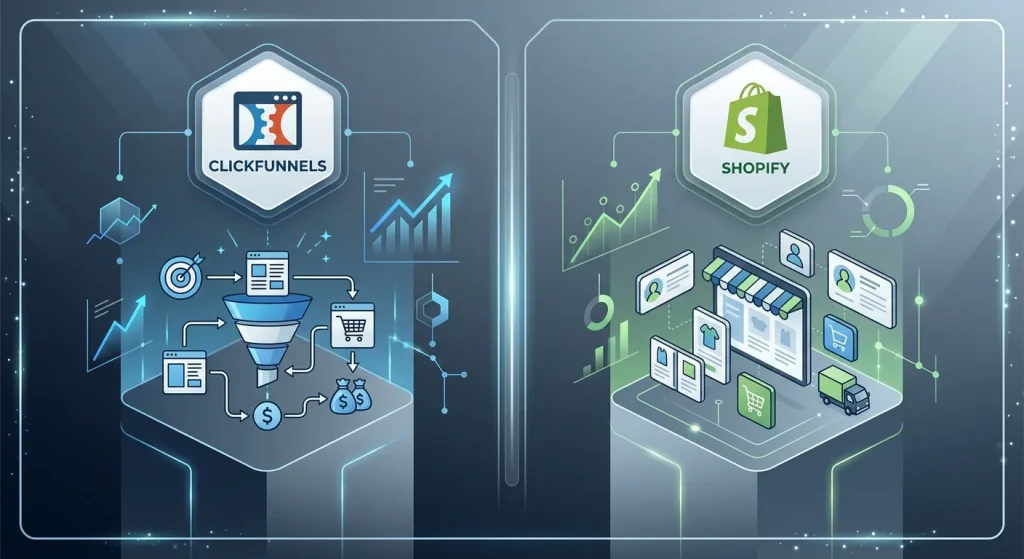
Quick answer. In the ClickFunnels vs Shopify comparison, ClickFunnels is built for funnel driven sales, a single offer, course, or high ticket product sold through a guided page sequence. Shopify is built for running a full ecommerce catalog, multiple products, inventory, and long term store growth. Neither is a better platform overall, they solve different problems, and the right choice depends entirely on what you’re actually selling and how.
| If you are… | Choose |
|---|---|
| Selling one course, offer, or high ticket product through a sales sequence | ClickFunnels |
| Running a catalog of multiple products with inventory to manage | Shopify |
| A coach or consultant focused on lead generation and a single funnel | ClickFunnels |
| A retail or dropshipping brand planning to scale a product catalog | Shopify |
| Wanting strong native SEO and long term organic traffic | Shopify |
| Wanting to use both for different jobs in the same business | See the section below on using them together |
Side by Side Comparison
| Factor | ClickFunnels | Shopify |
|---|---|---|
| Starting price | 97 USD a month (Launch), 81 USD a month annual | 39 USD a month (Basic), 29 USD a month annual |
| Top tier price | 297 USD a month (Optimize), plus a 5,997 USD a year Dominate plan | 399 USD a month (Advanced), scaling to Shopify Plus from around 2,300 USD a month |
| Core purpose | Funnel building, offer sequencing, lead capture | Full ecommerce catalog and store management |
| Product catalog handling | Limited, built around single offers and upsells | Extensive, built for large multi product catalogs |
| SEO capability | Limited native SEO controls | Strong native SEO, custom URLs, sitemaps, blog, extensive SEO app ecosystem |
| Payment processing | Native Payments AI, or your own Stripe with an added 1 percent gateway fee | Wide native and third party payment gateway support |
| Template and design depth | Funnel and page templates, less catalog focused theming | Extensive theme ecosystem built for product heavy storefronts |
| App and integration ecosystem | Smaller, funnel focused app marketplace | Very large app ecosystem, thousands of integrations |
| Best known for | Sales funnels, course and offer launches | Full featured ecommerce at any scale |
Pricing above reflects each platform’s own official pricing page as of 2026, and it’s worth checking both directly before deciding, since pricing structures do change.
Pricing, the Full Breakdown
ClickFunnels currently offers four tiers. Launch costs 97 US Dollars a month, or 81 US Dollars a month billed annually, and covers core funnel building with a 10,000 contact limit. Scale costs 197 US Dollars a month, or 164 US Dollars a month annually, raising contact and team limits. Optimize costs 297 US Dollars a month, or 248 US Dollars a month annually, adding advanced optimization and affiliate management tools. Dominate is billed annually only, at 5,997 US Dollars a year, aimed at agencies and larger operations needing multiple workspaces.
Shopify offers a comparable tier structure built around catalog size rather than contacts. Basic costs 39 US Dollars a month, or 29 US Dollars a month annually, covering a full online store. Grow costs 105 US Dollars a month, or 79 US Dollars a month annually, adding staff accounts and stronger reporting. Advanced costs 399 US Dollars a month, or 299 US Dollars a month annually, for higher volume stores. Shopify Plus starts around 2,300 US Dollars a month for enterprise scale operations.
The structural difference matters more than the headline numbers. ClickFunnels pricing climbs primarily with contact and email volume, since it bundles CRM and email functionality into the platform itself. Shopify pricing climbs primarily with transaction volume and feature depth, since its core job is catalog and order management rather than contact list size.
Core Purpose and Origin
ClickFunnels launched in 2014, built specifically around the sales funnel, a sequenced series of pages designed to move a visitor from initial interest to purchase, often with upsells and order bumps along the way. It grew out of the direct response marketing world, built for course creators, coaches, and single offer sellers who needed a guided path to one specific outcome.
Shopify launched in 2006, built to let merchants run a complete online store, product catalog, inventory, checkout, shipping, and everything else a retail business needs, at any scale from a single founder to enterprise brands. Its DNA is ecommerce infrastructure, not persuasion sequencing.
Ecommerce and Product Management
Shopify is built specifically for managing a real product catalog, tracking inventory across variants, handling multiple product types, and scaling into hundreds or thousands of SKUs without the platform itself becoming the bottleneck. ClickFunnels can sell physical products, but its product management tools are noticeably thinner, built around a small number of core offers and their associated upsells and order bumps rather than a large, browsable catalog. A business selling 5 to 10 core products through a guided funnel can work well on ClickFunnels. A business managing hundreds of SKUs with ongoing inventory needs is a much better fit for Shopify.
Funnel Building Capabilities
This is where ClickFunnels has a clear structural advantage. Its entire platform is built around designing multi step funnels, landing pages, order forms, upsell and downsell sequences, and thank you pages, all connected with built in analytics on where visitors drop off. Shopify can replicate parts of this through apps, and its Shop Pay and checkout experience has improved considerably, but it isn’t built primarily as a funnel sequencing tool the way ClickFunnels is from the ground up.
Templates, Design, and Themes
Shopify’s theme ecosystem is considerably larger and more focused on product presentation, built for browsing a catalog attractively rather than a single guided path. ClickFunnels’ templates are built specifically for funnel pages, optimized for conversion at each step of a sequence rather than general catalog browsing. Neither is objectively better here, the right fit depends on whether your business needs a browsable storefront or a guided sales sequence.
SEO Capabilities
Shopify has meaningfully stronger native SEO tools, customizable URLs, sitemap generation, a built in blog, canonical tag handling, and a large ecosystem of dedicated SEO apps. ClickFunnels offers more limited SEO controls, since its funnel pages are generally designed to be found through paid traffic or direct links rather than organic search discovery. A business planning to invest seriously in long term organic search traffic is generally better served by Shopify’s SEO foundation.
Integrations and App Ecosystem
Shopify’s app ecosystem is dramatically larger, covering everything from shipping and inventory to marketing and customer service, reflecting its much larger and longer established merchant base. ClickFunnels’ integration ecosystem is smaller and more focused specifically on marketing and funnel adjacent tools, email platforms, webinar software, and payment processors relevant to its core use case.
Ease of Use and Customer Support
Both platforms are generally considered approachable for non technical users, though the learning curve differs by task. ClickFunnels is often described as faster to get a first funnel live, since its editor is built around a linear, guided setup process. Shopify has a broader initial learning curve given how much more it can do, but its documentation and app ecosystem give users more ways to solve a specific problem once they understand the basics. Both offer standard support channels, with response quality varying by plan tier on each platform.
Which Should You Choose, By Business Type
Course creators and coaches selling a single program or offer through a guided sequence are typically better served by ClickFunnels, given its purpose built funnel and upsell tools.
Dropshippers and retail brands managing a growing product catalog are typically better served by Shopify, given its inventory management, catalog scalability, and stronger SEO foundation.
High ticket coaches and consultants running a lead generation funnel toward a sales call are typically better served by ClickFunnels, since the entire platform is optimized around that specific sequence.
Established retail brands planning long term organic growth and a broad product range are typically better served by Shopify, given its SEO strength and app ecosystem depth.
Can You Use ClickFunnels and Shopify Together
Yes, and this is a genuinely underused option worth considering rather than treating the decision as strictly either or. A common setup uses ClickFunnels as the front end for a specific high converting offer, a product launch, a limited promotion, a lead magnet funnel, while Shopify continues running as the backend catalog, inventory, and fulfillment system for the broader store. Orders from a ClickFunnels funnel can be routed into Shopify for fulfillment through available integrations, letting a business use ClickFunnels’ funnel strength for a specific campaign without abandoning Shopify’s catalog and operational infrastructure for the rest of the store. This hybrid approach suits a Shopify store launching a specific new product or running a time limited promotion that would benefit from a dedicated, highly optimized funnel rather than a standard product page.
Where AccelAsia Fits In
AccelAsia is a certified Shopify Partner, so this comparison is written to be accurate and useful regardless of that relationship, since the right platform genuinely depends on the business, not on which platform an agency specializes in. For businesses that land on Shopify, whether standalone or in combination with a ClickFunnels funnel for a specific campaign, AccelAsia handles development, from theme setup to integration work, alongside the Marketing and AI Optimization needed to actually drive traffic to it. For more on evaluating a Shopify development partner, see our guide on why you should hire Shopify experts, and for a full Shopify pricing breakdown, see our guide to Shopify pricing. You can see the full range of services on our services page.
Frequently Asked Questions
1. Is ClickFunnels an ecommerce platform?
- ClickFunnels can sell physical and digital products, but it’s built primarily as a funnel and sales sequence tool rather than a full ecommerce platform. It lacks the deep catalog and inventory management tools a dedicated ecommerce platform like Shopify offers.
2. Can you do SEO on ClickFunnels?
- ClickFunnels offers limited native SEO controls compared to Shopify. It can work for pages primarily driven by paid traffic or direct links, but businesses prioritizing long term organic search growth are generally better served by a platform with stronger native SEO tools.
3. Is Shopify or ClickFunnels cheaper?
- Shopify’s entry price is lower, starting at 39 US Dollars a month compared to ClickFunnels’ 97 US Dollars a month, though ClickFunnels bundles CRM and email functionality that would otherwise be a separate cost on Shopify, so a direct price comparison depends on what tools a business would otherwise need to pay for separately.
4. Can I use ClickFunnels and Shopify together?
- Yes. A common setup uses ClickFunnels as a dedicated funnel for a specific offer or campaign while Shopify continues handling the broader catalog, inventory, and fulfillment, with orders routed between the two through available integrations.
5. Which is better for a course creator, ClickFunnels or Shopify?
- ClickFunnels is generally better suited to course creators and coaches selling a single offer through a guided sales sequence, given its purpose built funnel, upsell, and order bump tools, though Shopify can also sell digital products through its own catalog if a broader product range is planned.
Final Thoughts
ClickFunnels and Shopify solve different problems well rather than competing directly on the same job. ClickFunnels wins for a single, guided sales sequence. Shopify wins for a scalable, SEO friendly product catalog. The right choice, or the right combination of both, comes down to what you’re actually selling and how, not which platform is generically better.
Building on Shopify and want it set up to actually convert, whether standalone or alongside a funnel tool for a specific campaign? AccelAsia is a certified Shopify Partner handling development, marketing, and AI optimization for brands in Sri Lanka and internationally. Get in touch to get started.